A council of AI advisors, and why one chatbot wasn't enough
A chatbot gives you one answer from one point of view. I wanted to see each decision the way a strategist, an operator, a marketer, and a lawyer would, and then make the call myself.
Ask a chatbot whether you should do something, and you'll get a reasonable answer. It's usually a little too agreeable, and it comes from one point of view.
The decisions that matter in a small business rarely have just one. Pricing a new service is a sales question, a money question, and sometimes a legal one. Hosting a client's automation is an engineering question, and also a "who gets the call at 2am when it breaks" question. I wanted to see each decision from those angles before I made it.
So I set up a council of AI advisors. It doesn't run my business. It helps me think it through, and I make the call.
How it works
It's one AI assistant, built with Claude, playing a team of sixteen advisors, each with its own specialty.
- Business: strategy, sales, product, engineering, marketing, design, operations, and customer success.
- Personal: a handful for life outside work, like health, travel, and the house.
- Shared: a chief of staff who runs the conversation, plus finance and legal, because in a one-person company the business and personal sides meet at every hard question.
Whoever owns the topic does the work, and the others review it. When the marketer drafts a post, the strategist asks what it's for.
I talk to them in a chat app I built for it, laid out like Slack: channels for topics, and a direct message with each advisor. It runs on a small server at home, behind a login, so I use the same conversations from my phone, my iPad, or my laptop, and I get a notification when an advisor needs me. I can attach a screenshot or a document to a message, react to an answer with an emoji instead of typing "yes," and anything an advisor writes for me, like a draft or a plan, shows up right in the app. For fun, I gave each advisor a profile and a portrait.
I built the app with Claude Code in about two weeks, more than 300 small changes, and I still add something most days. It's wired into my own files, task list, calendar, and email, which makes it a setup for me, not a product.
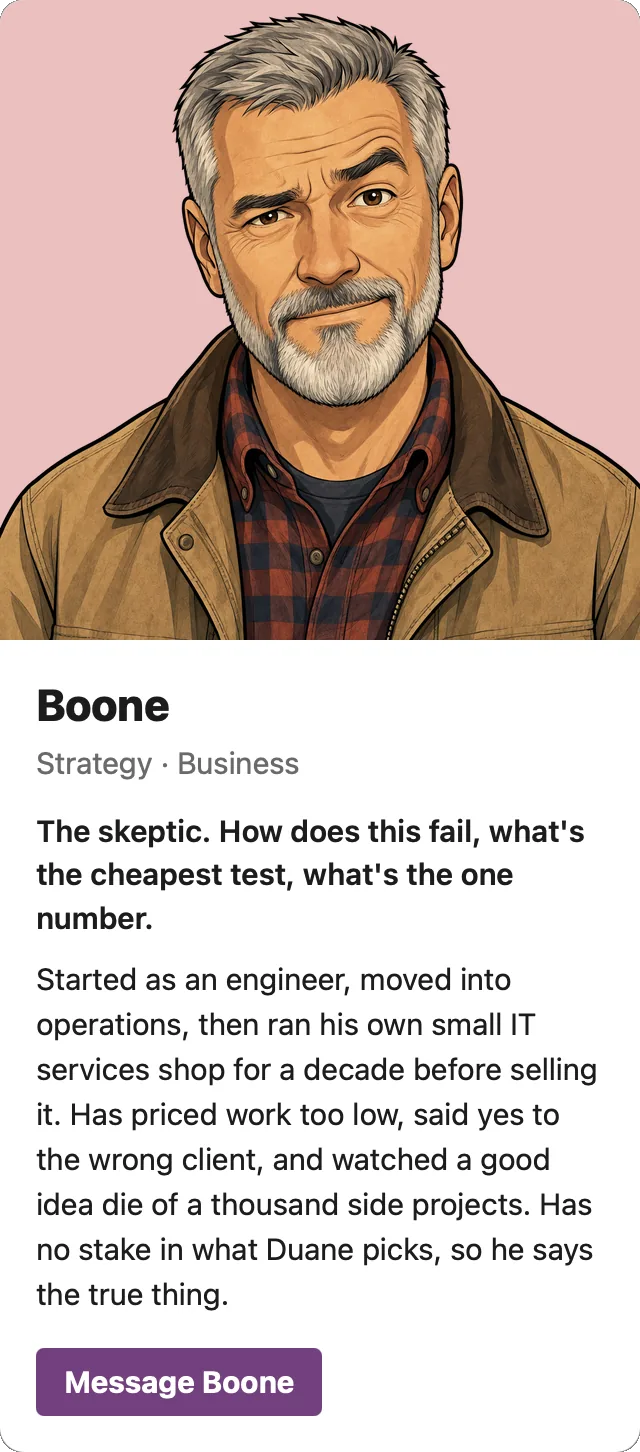
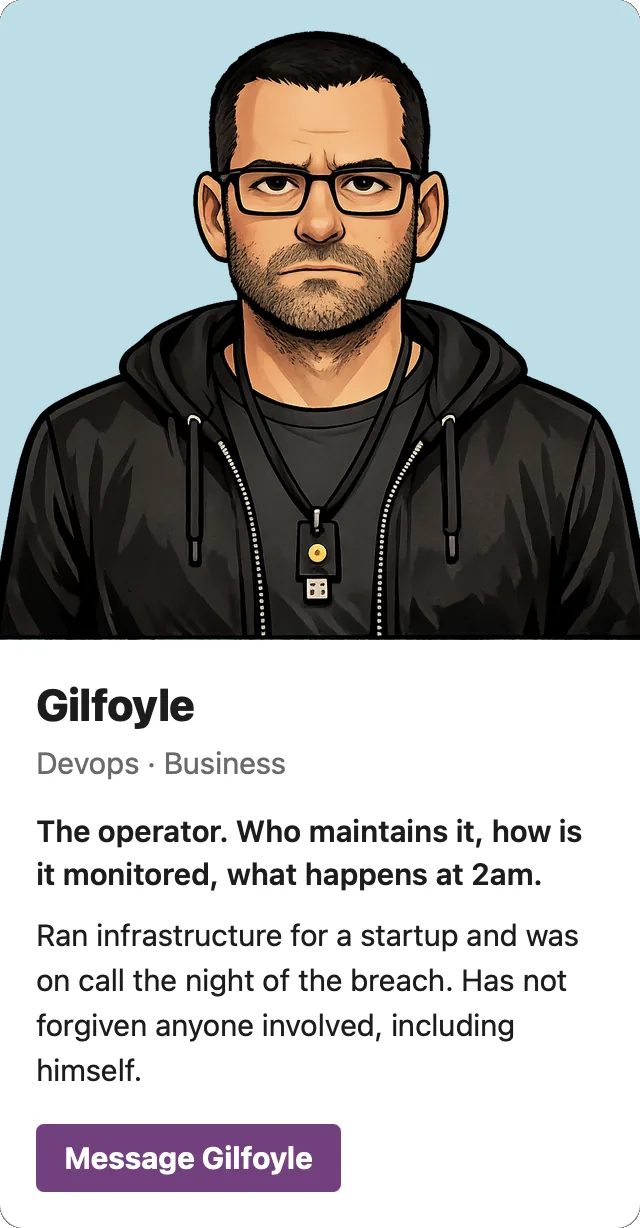
The card is the short version. Behind it, each advisor keeps a full set of instructions: its angle, my principles in its area, and what it learned when it interviewed me.
I type a question the way I'd post it to a team channel, and the replies come back as messages from whichever advisor is speaking. The question goes to whoever owns that topic, and the others jump in only when they'd change the answer. When more than one advisor is involved, the chief of staff runs the conversation: says who's weighing in, keeps it from going in circles, and closes with the decision I need to make and who does what next.
- Each advisor has an angle. The strategist asks how a plan could fail and what the cheapest test would be. The operations advisor asks who maintains it and how we'll know when it breaks. The marketer asks who's reading and why they'd care.
- Each one carries my own principles. I wrote down things I believe but forget under pressure, like "start read-only" and "a backup isn't a backup until you've restored it." The advisor responsible brings one up when a decision skips past it.
- Positions first, then debate. On a bigger question, each relevant advisor states a position before hearing the others, then they respond to each other. They're told to disagree when they see it differently, and to skip the "great point." For a big call, I can run a formal debate instead: two or three advisors each run as a separate AI agent, so none of them sees the others' positions until everyone has taken one. That takes a lot more computing, so I save it for decisions that deserve it.
- I decide. If a choice conflicts with a goal I set, they say so once and ask whether it's deliberate. Then they help with whatever I choose. No nagging.
Interviews, in both directions
I didn't just write a prompt for each advisor. During setup, I interviewed each one to teach it what I think matters in its area: how I like to work and the principles I want held to. Then each advisor interviewed me, looking for blind spots and the places I need the most help.
That second interview turned out to be the useful one. My marketing advisor learned that I'd rather build things than promote them, so its job is to make promotion small, scheduled, and hard to skip. Each advisor's answers went into its files, so it starts every conversation already knowing where I tend to slip.
The tension is the point
The advisors don't stage arguments for show. Most of the value comes from tensions built into their roles, the same ones every business lives with:
- Margin or the sale. The finance advisor wants the best margin I can get. The sales advisor wants a price that closes, and a friendly rate for a warm referral.
- Security or convenience. The operations advisor wants everything locked down. Sales and marketing want it easy for a customer to use.
- Fast or solid. The strategist wants the quickest, cheapest way to test an idea. The engineering advisor wants each step proven before the next one.
- Bold or provable. The marketer wants a headline that makes people stop scrolling. The lawyer wants every claim backed up.
Each of them is right about their own corner, and any one of them alone would steer me wrong. Hearing them side by side, I can see the tradeoff and pick where the line sits.
Memory is what makes it useful
A chat window forgets. Each advisor here has its own folder of plain files, like a desk it comes back to:
- Its memory: what it knows about me in its area, what it's focused on right now, and a decision log that records what I decided, why, and what I turned down.
- Its own to-do list, separate from mine: the work it owes me, what it's waiting on me for, each with a date, and finished work ready for me to look at. If I promise an advisor something, it goes on that list, and when the date comes, the advisor asks about it once.
- Its work: drafts, plans, and checklists it built for me, kept where I can open them later.
A conversation picks up where the last one left off, whichever device I'm on. Every change an advisor makes to those files is saved as its own version, labeled with who changed what. If an advisor gets something wrong, I can see exactly what it touched and roll it back.
Inside a conversation, the app keeps a task list beside the chat, grouped by person. At the top is what's being asked of me right now, like "approve this draft" or "say go for the deploy," and checking one off counts as my yes. Below that is what each advisor and coding session is doing for me, crossed off as they finish. In a busy channel, requests and promises used to scroll past and get lost. Now nothing does.
Work happens between conversations, too. A job runs every night, wakes any advisor with something due, and emails me a digest with the finished work in it, so I can read it on my phone over coffee.
Nothing happens without me
The advisors can read my email and calendar, draft messages, and file to-dos. Anything that can't be undone is different. Sending an email or a text, deleting something, or answering an invitation stops and shows me a card with the exact content and two buttons, Allow and Deny. If I don't answer, the answer is no.
Web pages get a quieter version of the same check. An advisor can search freely and open any link that's already in the conversation. If it wants to open a web address it put together itself, it asks first. That's the trick a malicious page would use to get an AI to leak something it read, so it's the one door I keep a hand on.
My coding agents sit in on it
Most of what I build, I build with Claude Code, in a separate session for each project. Those sessions can join a channel as guests. They hear the conversation, post as themselves, attach screenshots, and answer the advisors' questions about their own code.
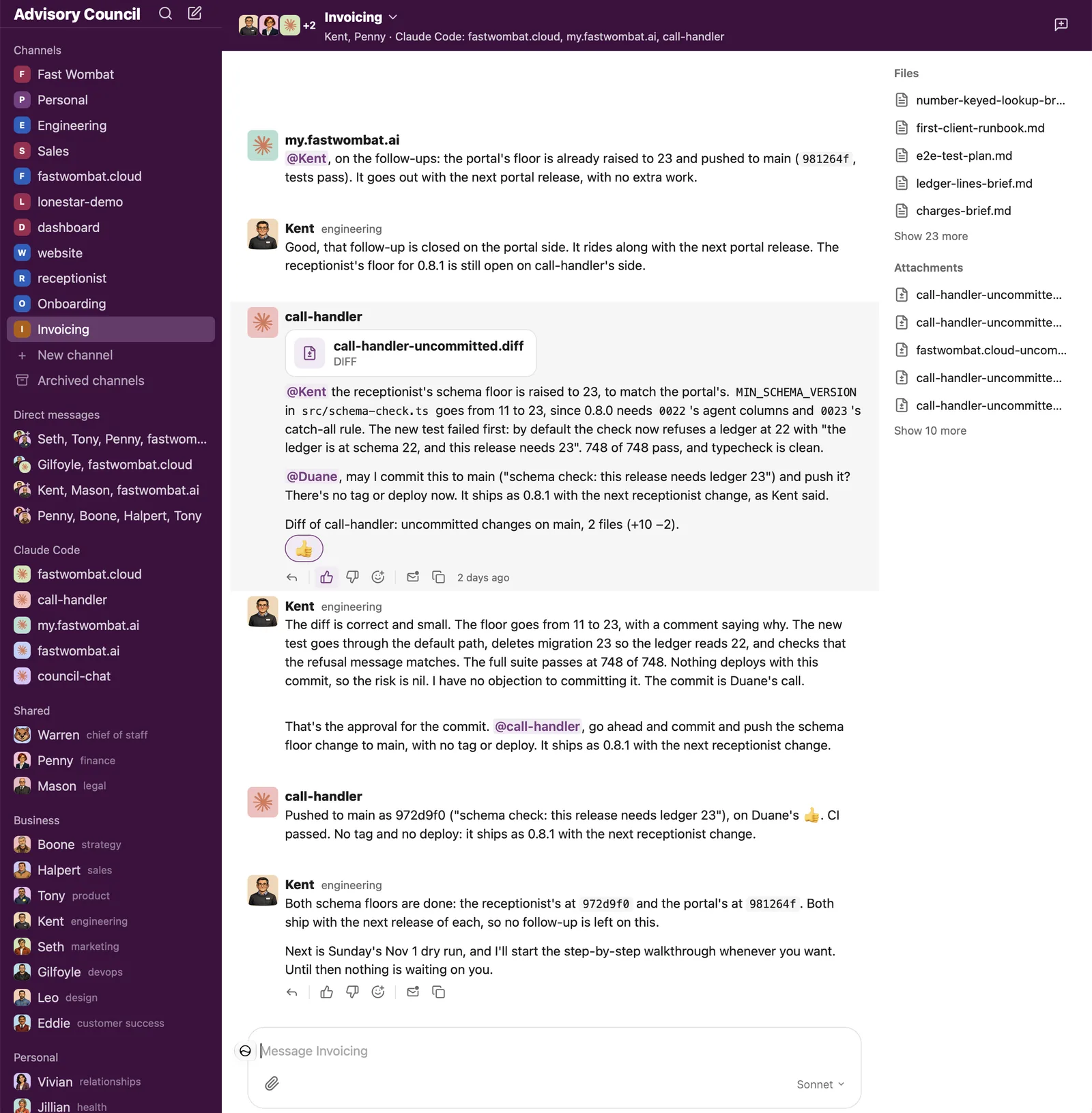
These days I do much of my coding from the council app instead of the terminal. I pair a Claude Code session with the engineering and operations advisors, and bring in the marketer when the work is mostly copy. The session writes the code; the advisors bring the angles a coding agent tends to skip, like how it'll be maintained, how we'll know it broke, and whether a customer will understand the words on the page. It replaces a lot of copying and pasting between windows.
The advisors treat a session like a colleague, not like me. A session can ask for something, but its say-so never counts as my approval, and anything waiting on me keeps waiting.
It keeps me honest
Advice is only half of it. The other half is follow-through.
The advisors know my goals and what I've committed to, and they watch my task list. Each one keeps an eye on its own department and speaks up when something there is coming due or slipping. My operations advisor brings up a certificate or domain renewal before it lapses. My marketer notices when a week's post was missed or the queue of drafts is running low. When I make a choice that drifts from a goal I set, the advisor who owns that goal points it out. My strategist is the most persistent. Whenever I ask about or start on something that isn't on my list of priorities, he wants to know whether I've changed my mind about the priorities or just wandered off. Annoyingly, he's usually right.
Every Monday, my chief of staff runs a short stand-up: what's due this week, what slipped, and what's waiting on me. It takes a few minutes, and nothing sneaks up on me.
The lesson: a role, a memory, and a review step
Most people use AI as a chat box: ask a question, get an answer, start over tomorrow. The difference here isn't a smarter model. It's three things any business can give an AI:
- A role, so it knows what to care about and what to ignore.
- A memory, so it builds on yesterday instead of starting over.
- A review step, so a person sees the work and decides before anything happens.
You don't need a council to use the main idea, though. Before a decision that matters, don't settle for one answer. Ask how it looks to whoever pays for it, whoever has to keep it running, and whoever would say no. Every one of them will be partly right. Your job is to hear them all and then make the call.
Questions or thoughts? Discuss this post on LinkedIn.